NOTE: From the archives of Daily Disciples Ministries circa 2008, we are sharing a message from a lesson taught almost 20 years ago, and though some references reflect a different time period, the overall message from the Word of God is applicable, timely, powerful and never returns void. The transcript is not written, by or with AI, so please forgive grammatical errors and other imperfections.
The book of Malachi is the last book of the Old Testament, the last words spoken from God through the prophet Malachi, then silence for 400 years. God addressed the motives of the people’s hearts and clearly made His desires known, starting with “Who’s your master?”
“A son honors his father, and a servant his master. If then I am the Father, where is My honor? And if I am a Master, where is My reverence?”
— Malachi 1:6 (NKJV)
The priests in Malachi’s day knew exactly how to offer a sacrifice: the best lamb, spotless and unblemished. Instead, they brought the blind, the lame, and the sick, and then wondered why God wasn’t pleased. They were going through the motions, but their hearts weren’t in it.
It’s easy for us to do the same. We give God our leftover time, our distracted worship, our “I’d throw it away anyway” giving. But God isn’t looking at the gift; He’s looking at the heart. He asks us to magnify Him, to honor His great name, and to hold Him in holy reverence.
If we don’t consciously make the Lord our master each morning, something else will quietly take the job.
Reflect: What “blemished offering” have I been bringing to God lately?
Pray: Lord, be my Master today. Show me where I’ve given You less than my best, and change my heart by Your Spirit. Amen.
Listen to the Full Teaching
In this 27-minute lesson, Bobbye Brooks walks through Malachi 1 and three truths: the Lord is to be magnified, His name is great, and His name is to be feared.
PODCAST Listen and subscribe on Podbean.
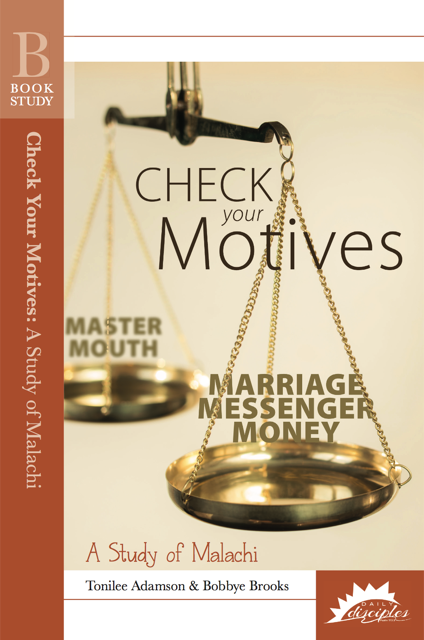
Check Your Motives: A Study of Malachi, Daily Disciples Ministries Bible Study Collection Tonilee Adamson and Bobbye Brooks available on Amazon
Full Transcript
Read the full transcript
Transcript lightly edited for readability. Scripture quotations from the New King James Version.
Welcome & Who Was Malachi? (00:00)
Hello, my name is Bobbye Brooks. I want to welcome you to our study in the book of Malachi called Check Your Motives. The name Malachi means messenger of God. We don’t know a lot else about Malachi. We don’t really know when he was born or when he died. There’s not a lot of history recorded about him as there are other prophets.
But the bottom-line message he had was the most important one of all, and that was he was sent to deal with God’s people. God wanted to get their attention. You see, God’s people had been raised up as a chosen nation, a royal priesthood to go and live and bear witness of God. Isn’t that how we are today as Christians? Aren’t we?
You know, the Bible tells us in the New Testament that we are a royal priesthood. We are a chosen generation to go and tell the good news of the gospel, bear witness of the message of Jesus Christ. Well, that’s what Malachi was sent to do, to remind the people that they weren’t doing this during this time in history. So they knew all the laws of God. They knew how to live. It would have been very clear through the generations of time and history how they were to really just live the life as God had put them here to live.
And the book itself is really going to address the motives of the priests, those who were called to minister to the people. Now you may think, why study a book in the Old Testament like this, a book called Malachi? You’re going to find out as you do this study how it is so applicable to our lives today as Christians. You’re going to be surprised even at the things you’re going to find that very much relate to our lives today.
Lesson 1: “Who Is Your Master?” (01:30)
So the first lesson we’re going to get into today is called “Who Is Your Master?” Master with a capital M. And we’re going to jump into chapter one, because really we need to identify some things here that are going to very clearly show us, first of all, why is it so important for us as Christians to know that God is our master, and secondly, how is it that we can make Him our master?
So the verses themselves are going to address the what, what’s going on. And we’re going to see some parallels. But we want to remember why it is so important to us and how we can do it. And you’re going to find that whenever these two things line up in your life, you’re going to find blessings. You’re going to find peace. You’re going to find the very things that we hear about, that we so much want, that Jesus promised us in the New Testament in the fruits of the Spirit.
Point 1: The Lord Is to Be Magnified — Malachi 1:1–5 (02:38)
So, let’s jump into Malachi chapter 1. If you have your Bibles, we’re going to start in verse 1 and read through the first five verses.
“The burden of the word of the Lord to Israel by Malachi. ‘I have loved you,’ says the Lord. ‘Yet you say, “In what way have You loved us?” Was not Esau Jacob’s brother?’ says the Lord. ‘Yet Jacob I have loved; but Esau I have hated, and laid waste his mountains and his heritage for the jackals of the wilderness.’ Even though Edom has said, ‘We have been impoverished, but we will return and build the desolate places,’ thus says the Lord of hosts: ‘They may build, but I will throw down; they shall be called the Territory of Wickedness, and the people against whom the Lord will have indignation forever. Your eyes shall see, and you shall say, “The Lord is magnified beyond the border of Israel.”’” (Malachi 1:1–5, NKJV)
So this is a burden that we’re seeing here that Malachi is giving the people. Now this is a very interesting, very debated, hot topic in Christian circles. And many people today talk about how is it that God can love Jacob and hate Esau? How is it that this God of love can hate anyone? Well, here’s where this whole master thing comes in. You see, we so often want to bring God down to our level. We want to bring God down to our understanding. We want to try to put even His own words in our context of thinking.
Did God love Jacob? Of course. He makes that very clear. Did He love Esau as well? Of course He loved Esau. The Bible tells us God is a God of love. He is love. However, He is also making a very clear distinction that there is a difference between how He is going to bless Jacob and his line, because that is the very line that Jesus Himself would come from. This is the line of people that God established His chosen nation in the first place. And Esau was not the one chosen by God. He was not the line. Why? Because God is God. This was His choice.
He did not hate Esau in our way of hating, no more than when Jesus says in the New Testament, you’re to hate your father, your mother, your brother, your wife, your husband, and follow Me. It is necessary for us at times to really be clear, not a lot of gray area here, but be very clear in who our master is, to be very clear in our hearts and minds who God is and that He has chosen us.
We know when Esau came out of the womb he was the firstborn, and he was blessed. When he and Jacob would meet later on in time, Esau was blessed. But the ultimate path for Esau’s life and Esau’s descendants was not to be as Jacob’s. So He’s making a clear line here. Esau did not follow the ways of God; his line of people were not taught the laws of God.
Bottom line for us, though, and I really want to make this point clear to you as you’re listening today: do not get hung up on some of these issues. Do not get hung up on trying to figure out why God said this or what God’s doing here. If we are chosen by the Lord and you have accepted Him as your Savior, or you say you know who God is and you want to follow Him, let that be your anchor.
Let that be the desire of your heart. In verse 5, when He says, “Your eyes shall see, and you shall say, ‘The Lord is magnified beyond the border of Israel,’” we want to first of all establish in our hearts the desire to magnify the Lord. God is making it clear through the prophet Malachi. He is saying to the people, “I am God. I am the one choosing. I am the one who is saying what is going to happen. My name is to be magnified.”
The word magnified, interestingly enough, means bound or twisted together. In other words, it is like this awesome tight strand that is growing, magnified, bigger and better. It also means that it is going to be great and powerful. So the bigger and tighter and stronger it gets, the more powerful it becomes, and that is who the Lord wants to be in our lives.
These are lessons that at times are very difficult for us to learn, because we in this world today don’t know what it is oftentimes to magnify someone else. We so often want to be magnified ourselves. I think most of us would agree that we live in a day and time where most of everything that is going on around us in this world is to either promote ourselves, promote what we want, get what we want, focus on what we want, instead of really taking our eyes off ourselves and looking at the Lord.
So let’s get our priorities right. Let’s get our focus back on Him. Let’s pray that He will be magnified in our lives. Let’s pray that everything we do will magnify Him. And if we do that, we will be blessed.
Point 2: His Name Shall Be Great — Malachi 1:6–11 (07:53)
Now let’s move on to the second part, because we’re starting to build on a message here. Now God is going to go a little bit deeper and start addressing how they’re actually treating Him. In verse 6, and you have to hear God through this. Even though Malachi is speaking, this is God’s voice to us today as well.
“A son honors his father, and a servant his master. If then I am the Father, where is My honor? And if I am a Master, where is My reverence? says the Lord of hosts to you priests who despise My name. Yet you say, ‘In what way have we despised Your name?’ You offer defiled food on My altar, but say, ‘In what way have we defiled You?’ By saying, ‘The table of the Lord is contemptible.’ And when you offer the blind as a sacrifice, is it not evil? And when you offer the lame and sick, is it not evil? Offer it then to your governor! Would he be pleased with you? Would he accept you favorably? says the Lord of hosts. But now entreat God’s favor, that He may be gracious to us. While this is being done by your hands, will He accept you favorably?” (Malachi 1:6–9)
In other words, God is saying, “Look at what you’re doing to Me.” Now, I want us to really think about this. So many of us quote, “Well, we’re to honor our father and mother,” one of the Ten Commandments. But do we? And God says, maybe some of you take more interest in honoring your earthly father than you honor Me. If a son is supposed to honor his father, where’s My honor as your heavenly Father?
Would you treat your governor this way? What if the president of the United States walked into your church? What would happen if he walked down the aisle? Don’t tell me we wouldn’t all sit up and take notice. What if you knew the president of the United States was coming to your church one Sunday morning? Would you not get up and put on your best clothes, throw the flip-flops in the closet, put on your nice shoes?
Now some of you out there, you already do that. I was raised in a church where we called it our Sunday-go-to-meeting clothes. We’d get up, we’d dress up, because we honored and revered God’s house. Today, a lot of times, we go to church as if we’re heading out to coffee with our hats on after working out. God says, “Honor Me.” So think about that. We so often honor others before we do the Lord.
Now see, the priests were taught how to perform the offerings on the altar. They were taught how to actually take the animals and kill them. There’s a very, very important point here. They were taught, trained, given the rules that that offering was to be perfect, unblemished, and spotless. The lamb was to have no blemishes. God made it very clear.
Now God is saying, “You’re offering blind sacrifices. You’re offering the lame and the sick.” In other words, the very gift that they’re going to bring to the Lord, instead of taking the best of the flock, they’re taking the worst. Now how often do we do that today? What measly sacrifices are we bringing to God?
Well, you may say, “Well, I write my check every month to church, or every week, or I give to the Lord in all these ways.” Okay, what do you give? Let’s say you’re someone who likes to give to the poor. “I have the Goodwill truck come by my house every month,” or, “I’m always donating clothes.” What clothes are you donating? Are they the ones in your closet that got torn or shredded or have paint on them, the ones you would just throw away? “Oh, instead of throwing them away, I should give them away.”
Well, you need to understand that God is looking at the attitude of your heart. Are you giving your best? And you may say, “Well, I’m not giving that to the Lord.” Jesus says whatever you do to the least of these, you’ve done for Me. So when we give to the poor, when we give to the needy, when we say anything that we’re giving unto the Lord, we need to take heed of what that gift is.
Because that’s exactly what they’re doing here, offering these sick sacrifices on the altar, saying, “Well, I’ve done my job, God. I’m Your priest. I’ve done what I was supposed to do. Here’s my daily offering,” because they had their daily rituals. In other words, they were going through the motions, but they weren’t getting it. There was nothing in their heart or attitude that was honoring the Lord.
One more example. Let’s say you’re heading to church, and you know you’re late. “Now it’s worship. They’re singing. It doesn’t matter if I miss that.” You see, that’s what we do. Or let’s say you actually make it to church and you’re there during the worship time and you’re singing. Where’s your mind? Are you really worshipping the Lord?
All these things we’re doing today, and it matters to God, because it’s not about our outward appearance. It’s not about our acts of good deeds. This is what they were doing. It’s not about our religion, it’s about our hearts, it’s about our attitudes. That’s what He’s addressing.
I want you to jump down to verse 11:
“For from the rising of the sun, even to its going down, My name shall be great among the Gentiles; in every place incense shall be offered to My name, and a pure offering; for My name shall be great among the nations, says the Lord of hosts.” (Malachi 1:11)
We looked at the first point. I want you to remember these key issues here. Number one, the Lord is to be magnified. For us to know who our Master is, we’re to magnify Him. Number two, His name shall be great. He has a great name. We’re to honor that name. We’re to revere that name. We’re to hold that name in such respect in our hearts.
Now, when He says, “From the rising of the sun, even to its going down, My name shall be great among the Gentiles,” let me put this in perspective for you. At this point in history, these are the Jews. These are God’s chosen people. They were the elite. The Gentiles were the heathens, the pagans, the idolaters. They’re the ones sacrificing to idols, dancing around the poles. So for Malachi to say this to the Jews, they’re thinking, “You’ve got to be kidding me. God’s going to bless the Gentiles? His name is going to be great among the Gentiles?”
Now, Malachi really was just hinting here at what would later come through Jesus Christ: that everyone, everyone would be offered an opportunity to be a part of God’s family. You see the arrogance and the attitude at this time. These priests, these “Christians” — I’m using Christian lightly, because in the Old Testament there were no Christians, but they were God’s people just as we are today — they were so arrogant in their thinking that they just had it made. “I’m saved. I’ve got it down. I’ve joined the church. I’ve been baptized. I’m just going to go through the motions.”
It happens to pastors, it happens to Bible teachers, it happens to ministers. We’ve got it down. We just go do what we do. Let me tell you something. All that matters to the Lord is that from the rising of the sun till its setting, we are praising His name, we are worshipping Him in spirit and truth, in the attitudes of our hearts. It doesn’t matter to Him, all of these activities, this religious stuff, this legalism that we’re doing that somehow makes us feel better that we’ve checked it off our list. They mean nothing to the Lord, because it’s not from our heart.
And that’s what we’re dealing with here. He said someday My name would be great among the Gentiles. For us, we need to remember when Jesus said the first shall be last and the last first. We need to be careful of our attitudes at times whenever we look at others and think, “You heathen. You don’t even know what you’re doing. I feel so bad you don’t even know the Lord. You’re such a sinner.” We need to be careful in our judgments against others, because you see, God is judging our hearts.
And that’s what He’s doing here. Do you make the name of the Lord great? Is the name of the Lord so great in your life that you think about how you go to church, or you think about your activities, or you’re really aware of the sacrifices you’re bringing to God? See, Malachi had a message of rebuke. It wasn’t a feel-good message. It wasn’t a tickle-your-ear message. It wasn’t an “Oh, it’s going to be okay because God loves you” message.
When God said, “I love Jacob and I hate Esau,” God is saying, “Look, I am God. I am Master.” We are going to serve a master, someone, something of some sort. But our master had better be the Lord. As a Christian, it has got to be the Lord. Anything outside of that, we have just sold ourselves short. If you’re serving any other master but God, you’re bringing defiled offerings to His altar. You’re doing a lot of things that are not blessing His name, and in turn, He can’t bless you. He can’t bless us when He is not first.
Point 3: His Name Is to Be Feared — Malachi 1:12–14 (17:09)
And then thirdly, let’s look at the final part of this chapter.
“But you profane it, in that you say, ‘The table of the Lord is defiled; and its fruit, its food, is contemptible.’ You also say, ‘Oh, what a weariness!’ and you sneer at it, says the Lord of hosts. And you bring the stolen, the lame, and the sick; thus you bring an offering! Should I accept this from your hand? says the Lord. But cursed be the deceiver who has in his flock a male, and takes a vow, but sacrifices to the Lord what is blemished — for I am a great King, says the Lord of hosts, and My name is to be feared among the nations.” (Malachi 1:12–14)
He said, “My name shall be great, but not to you, because you are profaning it.” In other words, He’s continuing back to say, “These offerings — should I accept this from your hands?”
And thirdly, my point: My name is to be feared among the nations. The name of the Lord is to be feared. Now here’s, I think, one of the greatest applications for us in this message. We should be in a place of reverent fear when we get to the point of realizing the Lord is not our master.
You see, the message for us, as it was for them, is to wake us up. We need to wake up. And I can tell you this from my own experiences. If I really believe that every day I get up and, oh, God is my master today, I have just said a foolish thing, because my desires in my flesh aren’t for God to be my master every day. For I get up and think about me, me, me. I want, want, want. And my prayers usually have to involve what I want God to give me. And yet what am I bringing to the Lord?
Now God doesn’t need the works. He wants our heart. He wants our attitudes. And He says, “My name is to be feared.” Well, fear means honor, reverence, awe. But it also means terrify, dread. There should be a part of us that has a holy fear. We should not be so comfortable sitting back and going, “Well, it doesn’t really matter what I bring, because in the New Testament it’s all about grace. The Old Testament was the law and the rules. And in the New Testament, Jesus says if you believe in Me and My blood has covered your sins, it doesn’t matter. It’s okay.”
Now there’s a lot of things that we toss around as Christians in Christianese today. And we take comfort in a lot of things to make sure that we’re okay with God. Well, I can only tell you that in the depths of your heart, even as you hear this message, I pray that Malachi himself, this messenger, the Holy Spirit speaking through us today, is the one that says, “Are you sure? Are you sure He’s your master? Are you sure it’s okay? When’s the last time you came to Me and said, ‘Lord, I’m sorry. My heart isn’t right with You’?”
Usually we do that whenever we have sinned and now we’re suffering the consequences, or we’re in a trial and that wakes us up. But let’s don’t wait till we get there. Let’s do it now.
A Trip to the Grocery Store: A Culture Without Reverence (20:09)
But you see, we live in a culture and a society that has no sense of reverence and respect. It’s so common in everyday life we don’t even think about it, Christian or non-Christian.
I went to the grocery store the other day, and as I pulled into the parking lot, I pulled into a place where there were several carts all piled together. You know what I’m saying? It happens. As I pull in, trying to dodge the carts so they don’t hit my car, I get out and I start to grab a couple of them, because literally two stalls down is the big giant cart holder where you put your carts. But no, no, no, let’s just stack all of our carts around some tree or somebody else’s space instead of taking them two spots over.
So then I go in, and as I’m walking through the grocery store I go back to the fish section. There’s a counter back there and there’s several people in line. I’m seeing the guys in the back talking, laughing, as we just continue to line up and wait on service.
This goes on. I go through the store and I’m getting ready to check out. I’m waiting in line to check out. The girl’s busy, so I go to the end of the counter and I’m bagging my groceries. I had a very large cart full.
So as I’m getting ready to leave, we’re all kind of piled up in this area trying to get out of the store. And I get stopped because there is a mother with a little boy, and she’s got this humongous cart, the one that has the little kid’s seat that you can sit in. But he doesn’t want to sit in it. So she’s standing in the middle of the aisle as several of us are trying to get by, and she’s saying, “Honey, get in the cart. Get in the cart. Let’s go, get in the cart.” And he says, “No.” She is literally on the floor negotiating with him to get in the cart, and he’s winning.
Finally I get around her, because she’s not paying any attention to anybody else around her but her two-year-old that she is trying to convince to get in the cart. He’s not respecting what she’s saying, and she is not saying to him, “Excuse me, I’m your mother. You’re going to get in that cart.”
I get around and I walk out and I think, of course there’s carts in the parking lot, because the customers don’t care enough to put them in the little bin. Because when they get into the store, they’re not going to get the service that the store is supposed to have anyway, because somewhere along the customer service lines of the world we have lost sight of what customer service really is. And then to top it all off, even in homes and families and with our parent-child relationships, the parent doesn’t know how to be a parent and the child somehow is in control.
Making God Your Master (22:45)
And we are supposed to understand what it means to make God our master? Who are we kidding? We don’t even know what master means. We have no master in our life. Master is whatever at the moment is ruling us. I’m here to tell you, you’re going to find in life, if that is your situation, frustration, depression, anxiety, sickness. You’re going to be constantly asking the Lord why He’s not doing something instead of how you can serve Him.
We’re so upside down today, and we wonder what is wrong. We need to take heed of what Malachi is saying to us today. It is time to make God our master.
Is the Lord your master? In my own life, I can tell you, if I don’t get up and be consciously aware every day that I need to pray for the Lord to be my master, something else will take over. It’s just human nature. It’s a fallen world, and no matter that we’re saved and God has saved us and sealed us, and the Holy Spirit lives in us, we still have to tap into that.
Invitation & Salvation Prayer (23:49)
So I invite you today, before we close this message: maybe you’re listening and you’ve never accepted Jesus as your Savior. Well, that’s the first step. Jesus came so that we would know who our Master is, that we would have a Master, our Heavenly Father, Lord God Almighty. See, master, in a simple definition, means owner. He owns you. He owns us because He created us. He just wants us to recognize that and honor it.
So if you’ve never accepted Jesus as your Savior, I want to invite you to do that. I’m going to tell you how. I’m going to lead you through a prayer. In the depths of your heart, just in the quietness of your heart, pray this prayer:
Oh Lord, I know that I have fallen so short. I don’t know You. I am dead in my sins. I can’t ever seem to get it right. I confess I’m a sinner, and I believe You died on the cross for me to save me from my sins. And I ask You, Jesus, to come into my heart right now and save me. Forgive me of all my sins and wash them clean, and make me whole and new in You. Fill me with Your Holy Spirit so that I may live the rest of my life asking You every day to be my Master. Help me to walk that out in obedience. In Jesus’ name, Amen.
That’s all you have to pray, and whatever words may come out, just remember it’s not your words. It’s the attitude of your heart. Many people are going to find themselves in heaven that we’re going to be surprised about, because the attitude of their heart was they asked Jesus to save them. That’s what matters.
Next Steps & Closing Prayer (25:23)
Now secondly, for those of us who know the Lord and are saying, “How can I change? How can I get started today?” let me give you some things to think about. Write these down.
1. Repent. Come to the Lord and say, “Lord, I am so sorry. You’re not my master. I have gotten so far away from really having reverence for You.” Maybe it’s things that you know you need to change in your attitude and your thoughts, how you go to church or how you give, or whatever it may be. Ask the Lord to forgive you. Repent and confess before Him those known sins.
2. Ask Him to show you. “Lord, help me to understand what it is to make You my master. Reveal to me and show me the ways that I can serve You with my heart. Help change my attitude through the power of Your Holy Spirit. Help me to get in Your Word every day. Help me to have a prayer life with You, so that we’re talking and these things don’t take over like they have so quickly in the past. Help me, Lord.”
That’s where we start. And if we’re willing to do that, whenever we can say, “The Lord is my master, and even though I may struggle with it at times, that is the prayer of my heart, that is the motive of my heart,” when we can say that and really walk it out, you are going to see blessings. We are all going to see blessings in our lives like never before, because God says so. That is His promise.
So I thank you for listening. I’m going to close in prayer for all of you, and may you be blessed as you continue to study this amazing book, the book of Malachi.
Lord, we thank You so much for Your Word. We thank You that You sent the prophet Malachi, not just so many years ago, but for us today. Help us, Lord, to make You our Master. Help us and show us how to walk this out with You, and forgive us, Lord, for all the times that we have fallen short. Thank You, Jesus, for Your promises. Thank You for Your Holy Spirit. In Jesus’ name, Amen.

